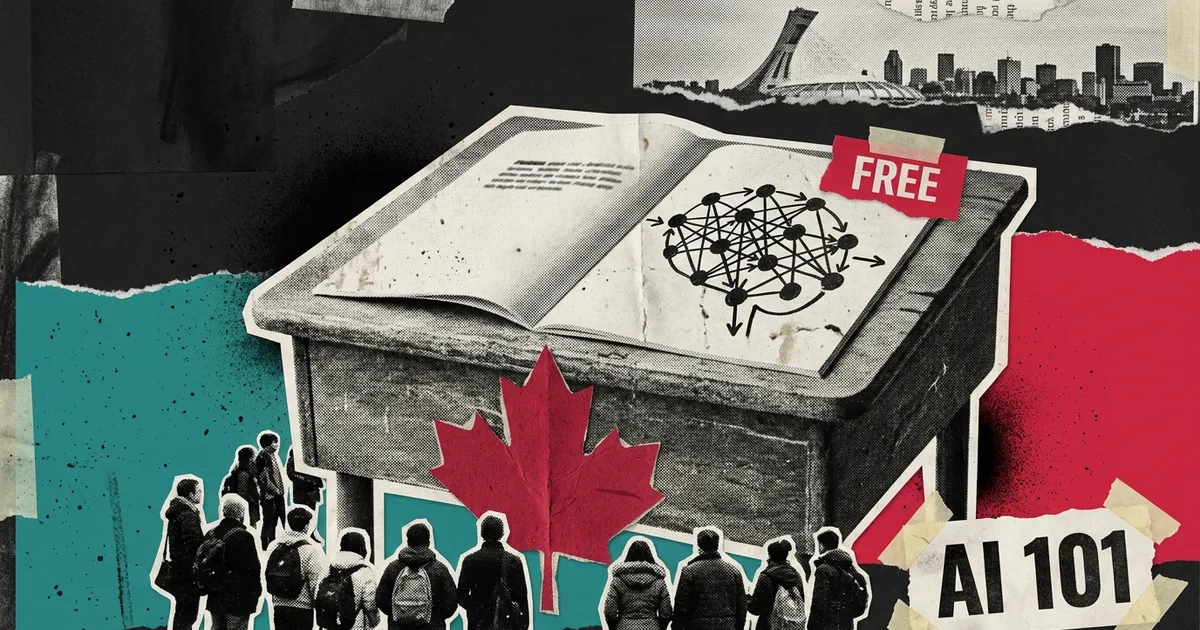
If you have been meaning to understand what artificial intelligence actually is before it turns up in your bank’s app, your kid’s homework and your inbox, the federal government has just made that free. On September 9, 2026, AI Minister Evan Solomon stood in the Alberta Machine Intelligence Institute in Edmonton and announced a National AI Literacy Initiative: a $13 million partnership with the institute, known as Amii, that launches on September 21 with courses for students, for teachers and for the rest of us (BetaKit, September 9, 2026).
It is the first of three AI moments packed into eight September days. On September 14 and 15 the Prime Minister hosts 100 global investors in Toronto, and the projects on the table include AI data centres in Alberta of up to two gigawatts (Canada Investment Summit 2026). On September 16 and 17, Montréal hosts ALL IN, the country’s largest AI conference, with 6,500 people expected (ALL IN 2026).
None of it asks anything of you. But it explains where the country is pointing its money, and one part of it, the free classes, is aimed squarely at people who feel behind. Here is what was announced, in plain language, with the sources.
The free classes: what was announced
The initiative is a partnership between the federal government and Amii, one of Canada’s three national AI institutes alongside Mila in Montréal and the Vector Institute in Toronto (AI for All strategy). According to BetaKit’s report from the launch, the $13 million program will be led by Amii and roll out in three streams: one for students, one for educators and one for the Canadian public, each focused on practical learning about the essentials of AI. The minister said the government is building on a course Amii already teaches.
“Students need to understand, educators need to understand, workers, parents, communities, [that] they need support and literacy, because education is the best hedge against change,” Solomon said, according to BetaKit.
What that course looks like is visible today. Amii’s AI Literacy for Everyone platform offers four foundational courses, more than 12 hours of on-demand learning, starting with defining key AI terms and using generative AI tools with effective prompting, then moving to strategy, risk and responsible use (Amii). Amii sells that platform as an annual subscription; the national initiative is meant to be the free version. How you sign up, and exactly which modules are included, arrives with the September 21 launch. We will update this piece when the enrolment page is live.
Why the government thinks you need it
The number behind the announcement is in the government’s own strategy. AI for All, launched June 4, 2026, cites the KPMG and University of Melbourne global trust study, which ranked Canada 44th of 47 countries on AI training and literacy and 42nd of 47 on trust in AI systems. The strategy’s diagnosis is blunt: initial adoption has happened, deeper and confident use has not, and “low literacy and low trust are the binding constraints.” Its commitment is to give all Canadians access to free AI literacy training, reaching one million entry-level post-secondary students and doubling K-12 teacher training to more than 3,000 educators (AI for All).
There is a money angle to literacy that the strategy does not spell out and that we cover every week. The scams that cost Canadians the most in 2025 were AI-assisted: cloned voices, deepfake celebrity endorsements, fake trading bots. They work on people who cannot tell a generated video from a real one. Understanding what a model can and cannot do is the cheapest defence there is, and our guide to AI crypto scams is the short version until the classes open.
The investor summit: what Canada is selling
The Canada Investment Summit runs in Toronto on September 14 and 15, hosted by Prime Minister Mark Carney together with CPP Investments and PSP Investments, two of the country’s largest pension investors. The government describes it as a first-of-its-kind gathering of global investors, Canadian chief executives and public officials, in service of a plan to catalyse $1 trillion of total investment in Canada over five years (canada.ca).
What is being pitched is, for now, reported rather than published. BetaKit says it obtained a 66-page pitchbook listing 167 projects, and that the Prime Minister’s Office told the outlet it did not share a prospectus with the media and that the document appears to have been leaked (BetaKit). Among the technology projects BetaKit lists: a data centre and behind-the-meter power project in central Alberta that could scale from 300 megawatts to one gigawatt, three “AI-ready” data centre campuses in Northern Alberta that could reach two gigawatts, a Calgary developer’s AI data centre hub, Toronto quantum company Xanadu’s $1.3 billion photonics hub in Etobicoke and a proposed Canada Sovereign Systems Centre in Ottawa seeking about US$427 million.
Canada's sovereign compute capacity is nascent, particularly in cloud, and significant investment will be required to overcome reliance on foreign providers. AI for All, Canada's national AI strategy, June 4, 2026
If the data-centre projects sound familiar to readers of this site, they should. The companies with the power contracts, the sites and the cooling experience in Alberta are often the same ones that mined bitcoin there, and several have been converting; we followed Hut 8, Keel and Hive in Canada’s bitcoin miners are turning into AI data centres. The summit is where that conversion goes looking for the money.
ALL IN: the conference
ALL IN takes over Montréal on September 16 and 17. The organizer bills it as Canada’s largest AI and tech event and expects more than 6,500 decision-makers and experts, 2,500 companies, 100 top Canadian AI startups and 200 speakers from more than 40 countries (ALL IN 2026). It is where Canada’s AI institutes, its startups and its ministers appear on the same stages, and after the week’s two announcements it is the obvious place for the government to say more about the literacy program’s enrolment and the compute money in the strategy. It is on our events calendar with tickets, and if you are a founder it is one of the two Canadian rooms our builder readers say are worth the trip.
What to watch after the week ends
Three dates. September 21, when the free courses open and we learn how Amii’s paid platform maps onto a national program. September 23, when the federal consultation on AI transparency closes; it asks how to label AI content, report serious incidents and track what AI agents do (Government of Canada, July 23, 2026), and we explained why that matters for anyone whose money an agent might one day spend in Canada’s AI rules in 2026. And the first announcements out of the investor summit, which will tell us which of the 167 projects in that pitchbook got a cheque.