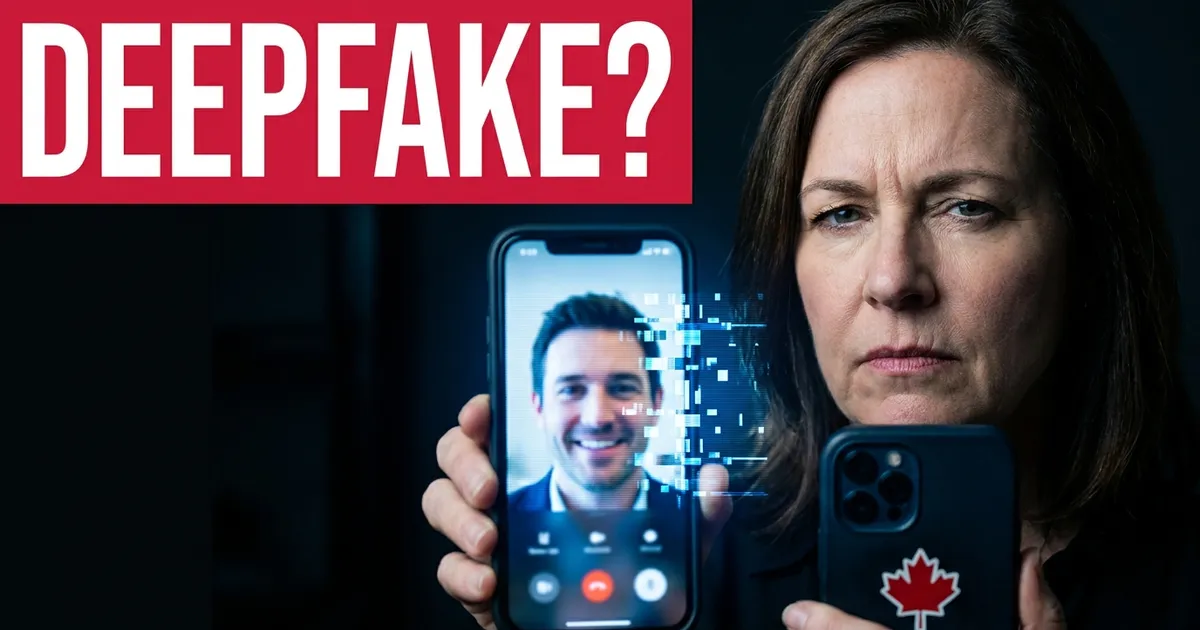
You saw a video of a famous Canadian telling you about a crypto platform that pays 3 percent a day. Or a friendly stranger on a dating app who wants to teach you how to trade. Or your nephew called from a number you did not recognize, crying, needing money tonight. Each of those is an old scam. What is new is that the video, the stranger and the voice can now be made by software in minutes, and that is why this guide exists.
You do not have to do anything today. Read the checks near the end, keep them somewhere you can find them, and use them the next time money is about to leave your account.
The numbers, and why they are low
The Canadian Anti-Fraud Centre, the national agency that collects fraud reports, said in March 2026 that “Canadians lost over $704 million to fraud in 2025, with reported losses since 2022 now surpassing $2.4 billion.” It added the line that matters most: “These losses represent only a fraction of the harm, because only 5% to 10% of frauds are reported.” By June 30, 2026 the centre’s running counter showed another $351 million lost this year, from 15,107 reports and 9,935 victims.
Investment scams are the expensive kind. In the centre’s 2024 report, they made up “49% of the overall dollar loss” reported, and crypto was the way the most money left: “Victims sent the highest number of payments and most amount of money via cryptocurrency, averaging $23,815 CAD per transaction due to investment, job and romance scams.” The average loss across every kind of fraud that year was $18,071. In 2025, the centre says, investment fraud, romance fraud and job fraud had the highest financial impact.
What AI changed
Two words you will see a lot. A deepfake is a video, picture or voice recording that AI has generated or altered so a real person appears to say or do something they never did. The Canadian Centre for Cyber Security defines it as “synthetic content that has been digitally manipulated and is intended to deceive” and warns that “deepfakes are getting easier to make and harder to detect.” A voice clone is the audio version: the B.C. Securities Commission’s investor site says plainly that AI “can clone anyone’s voice, and in just minutes, AI can create fake images or videos of real people.”
The Ontario Securities Commission studied what this does to ordinary investors. In a 2024 experiment, more than 2,000 Canadians invested a pretend $10,000 across six opportunities in a simulated social media feed. They “invested 22% more in AI-enhanced scams than in conventional scams.” The OSC found two trends: scammers “using generative AI to ‘turbocharge’ existing scams,” and scammers “selling the promise of ‘AI-enhanced’ investment opportunities.” That is the whole landscape in one sentence, so the next section takes each version in turn.
The old advice about spotting a scam by its spelling mistakes is wearing out. In a March 2026 Interac survey, 79 percent of Canadians said AI is helping fraudsters “create highly convincing scams faster than ever,” and 66 percent said traditional warning signs such as spelling mistakes or poor formatting are less reliable than they were.
The three versions you will actually meet
The celebrity deepfake ad. A video of a well-known Canadian, a business leader or a politician appears in your social feed, endorsing a crypto platform. The face and the voice are generated. Clicking leads to a slick site and a “specialist” who calls you. The Canadian Securities Administrators, the umbrella body for the provincial regulators, listed “fake endorsement involving a celebrity, athlete or politician on social media” among the red flags when it announced it had helped deactivate more than 7,586 fake investment platforms and crypto scam websites between June 5, 2025 and February 12, 2026, involving more than 13,000 web addresses. The OSC report describes an Ontario investor who, in 2022, was “deceived by a deepfake video of a notable public figure offering shares on a website,” downloaded remote-access software at the site’s request, and lost $750,000.
Avoid celebrity or public figure endorsements or investment opportunities promoted online. These are often AI-generated scams. Canadian Securities Administrators, news release, June 14, 2024
The AI trading platform. This one does not need a deepfake at all. It sells AI itself: a “bot” or “quant model” that supposedly trades crypto for you with guaranteed returns. The BCSC’s list of AI-related scams includes “unregistered investment platforms that claim they are using AI to generate guaranteed returns with little or no risk.” Real registered firms cannot promise guaranteed returns. In April 2026 the OSC issued an investor alert about a site calling itself SIMNA Artificial Intelligence Services, or Maple Quant, which “is not registered in Ontario to engage in the business of trading in securities.” The tell is usually the same: your dashboard shows profits, but when you try to withdraw, there is a “tax” or “fee” first. The CSA lists “requests for money when attempting to withdraw funds” as a red flag for a reason.
The voice on the phone, and the friend online. The CSA’s June 2024 release explains that “AI voice cloning allows scammers to impersonate family members or friends in urgent need of money,” and that AI can “create credible personas on dating sites and social media.” The dating version has a name, pig butchering: the Anti-Fraud Centre says it is “noticing an increase in a combination of romance and investment frauds,” where the new friend will “coach you on how to invest in their fraudulent crypto currency platforms.” The phone version is the emergency scam. The centre’s advice for a panicked call from a “relative” is to “hang up the phone and contact them directly using a phone number you already have,” and it notes that Canada’s justice system “does not allow for someone to be bailed out of jail with cash or cryptocurrency.”
There is a fourth version that follows the first three. After a loss, someone contacts you offering to recover the money for a fee. The Anti-Fraud Centre’s recovery-scam page is blunt: “Never pay an advance fee to obtain a refund,” and “never allow an unknown person to gain remote access to your computer/device.”
Five checks before you send a dollar
These are the regulators’ own checks, in the order that catches the most.
- Is the firm registered? Search the person and the company at AreTheyRegistered.ca, the CSA’s registration search. For a crypto platform, check the CSA’s list of platforms registered to do business with Canadians. If the name is not there, that is your answer. The registered platforms with a Canadian office are also in our directory of Canadian exchanges, each with the regulator’s own wording.
- Call them back on the listed number. The CSA’s advice is to confirm “the identity of the representative by calling the phone number listed” in the registration, not the number in the message. A real firm will not mind.
- Have you met a human? The CSA says: “Do not send money online to anyone or invest based solely on the advice of someone you have not met in person.” The BCSC lists “you cannot meet with a human in person” as a sign of an AI scam, along with “unusual body or lip movement in videos.”
- Did anyone ask for remote access, or a fee to withdraw? Both are on the CSA’s red-flag list. No legitimate platform needs to control your computer, and no legitimate platform charges a tax to release your own money.
- Wait a day. Every scam runs on urgency. In Interac’s 2025 survey, pausing to think before sending money was the top strategy Canadians named, at 62 percent. A real opportunity is still there tomorrow.
If you already sent money
Stop sending more, including any fee to “unlock” a withdrawal. Then report it, even if the loss was small or you feel embarrassed; the Anti-Fraud Centre says “you should still report the incident even if there was no financial loss.” Report to:
- The Canadian Anti-Fraud Centre at 1-888-495-8501 (weekdays, 10 am to 4:45 pm Eastern) or online at reportcyberandfraud.canada.ca.
- Your local police.
- Your provincial securities regulator, through the CSA’s site.
Reporting fast is what gives money a chance of coming back. On April 9, 2026 the OSC announced Operation Atlantic, which “identified more than $45 million (USD) in cryptocurrency from fraud schemes worldwide,” froze US$12 million of it, and traced “more than 20,000 cryptocurrency wallet addresses linked to fraud victims across more than 30 countries, including Canada.” Frozen funds are not the same as returned funds, but nothing gets frozen if nobody reports.
What Ottawa and the regulators are doing about AI
The rules are catching up slowly, and there is still no general AI law in Canada; our explainer on Canada’s AI rules in 2026 maps what applies instead. The federal government opened a consultation on AI transparency on July 23, 2026 that covers “detecting and identifying AI-generated content” and “helping individuals know when they are interacting with an AI system”; it closes September 23, 2026. The OSC’s research found that a short warning shown before people invested, which it called inoculation, cut money put into fraudulent opportunities by 10 percent, and a browser plug-in that flagged suspicious pages cut it by 31 percent. Until tools like that are in your browser, the five checks above are the plug-in. If you hold your own coins, the self-custody security guide covers the device and the backup, and the piece on what to do when a wallet maker leaks your data covers the phishing that follows a breach. The law tracker follows the rules that apply to the platforms themselves, and the newsletter carries every new regulator alert that touches Canadians.