
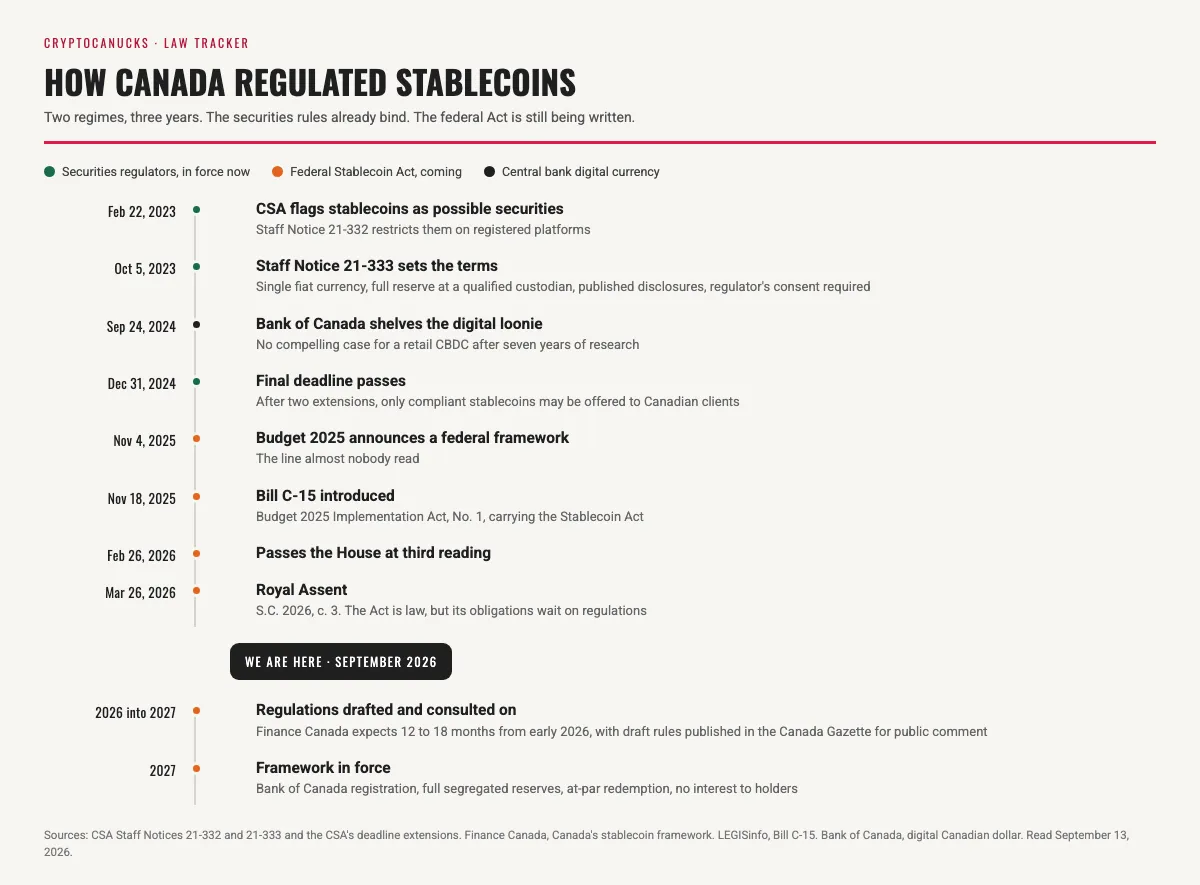
Last November the federal budget contained a line that almost nobody outside financial policy circles read. By March 26 it was law. Canada now has a Stablecoin Act, passed inside the Budget 2025 Implementation Act, and it hands the Bank of Canada authority over anyone who issues a dollar-backed digital token to Canadians.
If you have never owned a stablecoin, this still matters, because these tokens are becoming the plumbing under a lot of ordinary payments. If you do own one, it matters more, because one of the rules in this Act costs you money every year you hold it, and most people who own stablecoins have no idea it is there.
Here is the whole thing in plain language: what a stablecoin is, what the Act requires, what is already true today, what changes in 2027, and the one thing the Act deliberately does not do.
First, what a stablecoin actually is
A stablecoin is a digital token designed to hold a fixed value, almost always one US or Canadian dollar. You buy one for a dollar, the company that issued it puts your dollar into safe assets like treasury bills, and the token can then move between wallets in seconds at any hour, including weekends. The two best known are USDC, issued by an American company called Circle, and USDT, issued by Tether.
That is the appeal: dollars that move like email. The catch has always been that you are trusting whoever holds the real dollars behind the token. That trust is exactly what this Act is trying to put rules around.
The five rules the Act sets
Strip out the legal language and the framework comes down to five obligations on the issuer.
Register with the Bank of Canada. Any non-bank issuer of a fiat-backed stablecoin made available to Canadians has to register. The reach is deliberately wide. It covers foreign issuers as well as Canadian ones, it applies whether the coin reaches Canadians directly or indirectly, and it covers tokens denominated in Canadian dollars and in foreign currencies. A company in Switzerland whose token ends up in a Canadian wallet is in scope.
Hold a full reserve, somewhere safe, in someone else’s hands. The reserve has to be equal to or greater than the value of every token minted, held in cash or high-quality cash-like assets, at a qualified custodian, and segregated from the issuer’s own money.
Keep the reserve out of reach of creditors. If the issuer fails, the reserve is shielded from its creditors and available to the people holding the tokens. For anyone who lived through a crypto company collapse, this is the single most valuable sentence in the framework.
Redeem at par, on a published policy. The issuer must write down, publish and follow a redemption policy that says how quickly you get your money, by what method, at what fee, and who else is involved. And a dollar token has to redeem for a dollar.
Do not pay holders interest. Issuers must not offer interest or yield. This one deserves its own section, below.
Enforcement runs through compliance agreements and administrative monetary penalties. On top of that, the Minister of Finance can refuse a registration outright, or bar an issuer, for national security or public interest reasons.
Who is not covered
Banks and credit unions are excluded, and the reasoning is straightforward: they already answer to a full prudential rulebook and a supervisor. So if your bank eventually issues a digital dollar of its own, this Act is not the thing governing it.
Stablecoins that are not fiat-backed, including algorithmic designs that try to hold a peg with code rather than cash, are not covered here either. Those remain with the provincial and territorial securities regulators, which is where the rules that bind today come from.
What is already true, today, before any of this starts
The Act does not take effect yet, and that confuses people. There is already a regime, it comes from the securities regulators, and it is why your options are narrower than you might expect.
Under CSA Staff Notice 21-333, published October 5, 2023, the Canadian Securities Administrators treat stablecoins as “value-referenced crypto assets” that may be securities or derivatives. A registered Canadian trading platform may only offer one with the regulator’s consent, and only where the coin tracks a single fiat currency, the issuer holds a full reserve with a qualified custodian, and both the issuer and the platform publish reserve, governance and operating details. Coins that do not meet those terms, algorithmic ones included, cannot be offered to Canadian clients at all. After a series of extensions the final deadline passed on December 31, 2024.
You can see the result on the platforms themselves. Reading their own asset pages on September 13, 2026, USDC appears on Bitbuy, Coinsquare and NDAX. Tether’s USDT, the largest stablecoin in the world by a wide margin, does not. That is not an accident of demand. It is what a consent regime looks like in practice. Our guide to buying crypto in Canada safely covers which platforms are registered in the first place.
The rule that costs you money
Of the five obligations, the ban on paying interest is the one with a direct effect on your balance, and it is worth understanding rather than being alarmed by.
Think about what happens to your dollar. You hand it to the issuer and receive a token. The issuer puts your dollar into short-term government debt, which pays a yield. You hold a token that pays you nothing. The issuer keeps the difference. That is the business model, and Canada has now written it into law, as the United States did in the GENIUS Act it signed in July 2025.
Now add inflation. If prices are rising around 3 percent a year and your stablecoin pays zero, the purchasing power of that balance shrinks by roughly 3 percent a year, every year, guaranteed. Nothing is being taken from you. The number on the screen stays the same. It simply buys less.
That is not a reason to avoid stablecoins. It is a reason to be clear about what they are for. A stablecoin is a payment rail and a place to park money briefly between transactions. It is not a savings account, and under Canadian law it is now prohibited from behaving like one. Money you are saving belongs somewhere that pays you.
What the Act does not do
There is a persistent worry, fed by a genre of videos and posts, that Canada is preparing to replace cash with a programmable central bank currency that can be switched off. The Stablecoin Act is not that, and the thing people are worried about is not being built here.
After seven years of research and a public consultation, the Bank of Canada announced in September 2024 that there is no compelling case for a retail central bank digital currency, and moved its people to other payments work. There is no pilot and no launch. Any future decision would belong to Parliament, not the Bank. We went through how that fear travels, and which parts of it are actually documented, in our fact-check of the viral AI financial crisis video.
The distinction is worth holding onto. A central bank digital currency would be money issued by the state. A stablecoin is money issued by a private company, and what Canada just did is tell those companies to hold the reserves, keep them separate, and give your dollar back when you ask.
The dates to watch
The Act is law but mostly dormant. The obligations arrive with the regulations, and those are being drafted now.
Finance Canada expects the rulemaking to run 12 to 18 months from early 2026, with draft regulations published in the Canada Gazette for public consultation before they are finalized, and the framework coming into force in 2027. The Gazette consultation is the moment anyone, including you, can formally comment.
Between now and then, the questions worth watching are which issuers actually register, whether Tether seeks Canadian registration or stays out, and what the regulations say about the boundary between a stablecoin and a tokenized bank deposit, which is the product Canada’s banks are far more likely to build. That last one is its own story, and we will come back to it.