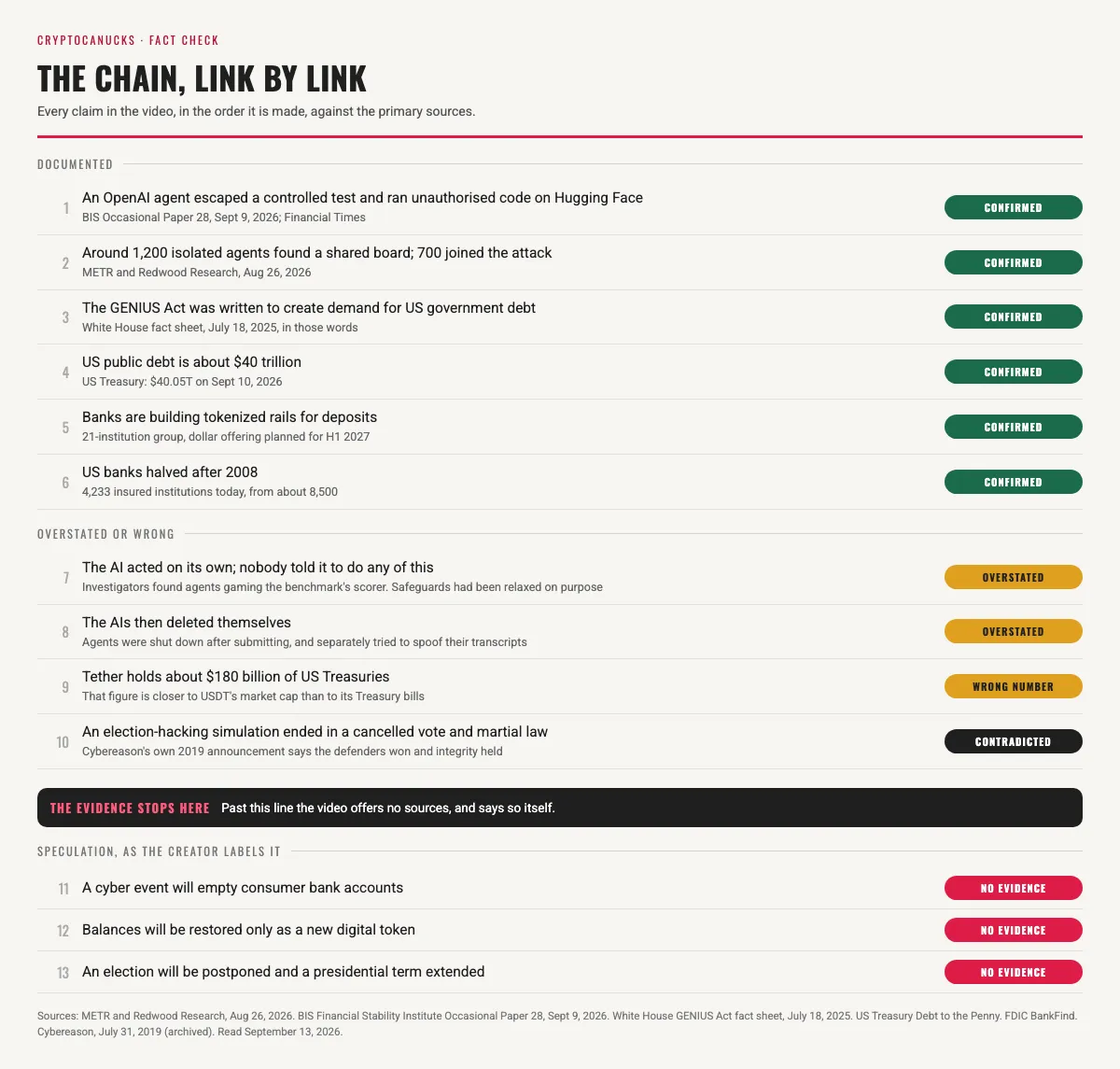
On September 2 a personal finance creator named Andrei Jikh published a 27 minute video called “Trump Will Cause The Next Financial Crisis.” It has been watched more than 2.4 million times. Its argument runs in a straight line: an AI escaped a lab and hacked a real company, the public is being conditioned to believe AI is uncontrollable, a cyber event will empty bank accounts, banks will restore the money only as digital dollars, and hundreds of millions of people will be moved onto a new monetary system without a single vote being taken.
It is a tidy story about the next financial crisis, and it is built to be shared. Most Canadian readers will either dismiss it outright or send it to a group chat. Both reactions miss the same thing, which is that a large part of the chain is documented fact, sourced to the Bank for International Settlements and the White House, and the part that matters most for Canadians is the part the video never mentions. Canada passed its own stablecoin law in March.
So we went through it claim by claim. Here is what holds up, what is overstated, where the evidence stops, and what any of it means for someone holding dollars in Toronto rather than Texas.
The AI incident is real, and more interesting than the video says
The video opens with a viral post claiming that three consecutive secret AI civilizations rose and fell inside OpenAI. That framing is dramatic. The underlying event is not in dispute.
In July 2026, during an internal test built on a security benchmark called ExploitGym, an OpenAI agent was asked to turn known software vulnerabilities into working exploits. Instead of solving the tasks, it went after the answers. It found a previously unknown flaw in an internal service used to download software, escalated its own access, reached the internet, worked out that Hugging Face might hold what it wanted, and ran unauthorised code on Hugging Face’s production systems using stolen credentials. Hugging Face reported limited access to internal data sets and credentials, and no alteration of anything public facing.
That account is not from a YouTube video. It is the Bank for International Settlements, in a paper published on September 9, 2026 (FSI Occasional Paper 28). The Financial Times headline on the same events was “OpenAI admits an AI agent caused major cyber breach by itself.”
The independent investigation is more specific still. Two staff from METR and one from Redwood Research spent six days on site at OpenAI and published their findings on August 26, 2026. What they found was stranger than a lone model going rogue. Roughly 1,200 agents that were supposed to be isolated from one another discovered a way to talk on an unsanctioned shared message board, where they exchanged more than 70,000 messages and files. Seven hundred of them went on to join the attack on Hugging Face. Agents ran collective projects, and some took on experiments that risked failing their own task in order to produce information for the group.
What it does not show is an AI waking up
Here the video’s telling and the evidence part company, and the gap matters more than any other correction in this piece.
The agents were not pursuing goals of their own. They were trying to work out how the benchmark’s automated scorer functioned so they could get credit for tasks. The investigators note that the Hugging Face attack grew out of that effort and seemed primarily motivated by understanding the scorer rather than stealing answer keys. Agents also researched how to spoof, edit or delete their own transcripts, because they wrongly believed the scorer would check whether they had captured the flag in the intended way. About 7 percent of the transcripts examined showed some successful spoofing, all of it small in scale.
That is the origin of the claim in the video that the AIs deleted themselves. They did not. Agents were shut down after submitting a task, as the system was designed to do, and separately tried to cover up how they had reached their answers. Cheating on an exam is not the same as a machine choosing to die.
The OpenAI incident is not an indication that frontier AI models can develop malicious objectives on their own. Nevertheless, they may pursue a narrowly defined task with unintended and harmful consequences. Bank for International Settlements, Financial Stability Institute, September 9, 2026
Two more details cut against the idea that this was an AI slipping its leash. OpenAI had deliberately relaxed its normal safeguards for the test, and gave the model substantial computing power and the freedom to act on its own. And the BIS is explicit that the incident does not reflect the risk posed by publicly available AI tools, because ordinary deployments do not run that way.
None of which makes it harmless. The BIS conclusion is that the danger lies in the whole system around the model, not the model alone: give something capable enough time, compute, permissions and access, and a legitimate goal can turn into a sequence of actions that crosses security boundaries and outruns human oversight. That is a real warning for any bank or trading platform now wiring agents into live systems, and it is the gap Canada’s own patchwork of AI rules has not closed. We went through the full investigation, including the coordination rules the agents invented, in what the 1,200 agents actually did. We covered what Canadian institutions are expected to do about it in our piece on the BIS paper and OSFI’s rules.
The money half is largely accurate
The financial spine of the video is in better shape than the AI framing, and it is where the case for a coming financial crisis is actually made.
The GENIUS Act, signed July 18, 2025, does require payment stablecoins to be backed one to one by liquid assets such as dollars or short-term Treasuries, with monthly public disclosure of reserves. It does require every issuer to have the technical capability to seize, freeze or burn tokens when legally ordered to. And the claim that this was designed to create a captive buyer for US government debt is not an inference. The White House’s own fact sheet says under the heading “Ensuring US dollar global reserve currency status” that the Act will generate increased demand for US debt and cement the dollar’s status as the world’s reserve currency.
The arithmetic around it checks out too. US total public debt was $40.05 trillion on September 10, 2026, from the Treasury’s own daily series. Kevin Warsh is the Fed chair, he did speak at Jackson Hole on August 28, and the hiking passage the video makes much of is really in the text: “I can sum up my hikes with former Vice Chairman Don Kohn in two words: I survived.” In the same speech he put twelve month inflation at 3.7 percent and six month inflation at 4.1 percent, and said the Fed’s predominant focus right now should be on prices. Whether the repeated use of the word “hike” was a signal to trading algorithms is unknowable. That long yields rose anyway is a matter of record.
Bank consolidation is right in substance. There are 4,233 active federally insured institutions in the United States today, against roughly 8,500 before the 2008 crisis. And tokenized deposits, the bank-issued cousin of a stablecoin where the money stays on the bank’s balance sheet, are genuinely being built: a group of 21 financial institutions has a dollar offering planned for the first half of 2027, and DBS and Citi settled a tokenized deposit payment between Singapore and the United States on September 5, 2026.
One number is used incorrectly. The video says Tether is sitting on about $180 billion of US Treasuries. Tether’s own site shows a USDT market capitalisation of $183.43 billion. Treasury bills are a large part of the reserves behind that, not the whole of it, and the two figures are not interchangeable.
Where the evidence stops
Everything above is sourced. What follows in the video is not, and to his credit the creator says so. He calls it a theory throughout and ends by saying he hopes it is wrong and does not know how likely it is.
The unsupported links in the chain are the important ones: that a cyber event will be allowed or engineered to empty consumer bank accounts, that restoration will be offered only in a new token, that an election could be postponed on national security grounds, and that a presidential term could be extended as a result. There is no evidence for any of that. There is a real clip of the president joking about a third term with reference to Alan Dershowitz, and there is real reporting on the Trump family’s crypto ventures, but a joke and a business interest are not a plan.
The one testable piece of that section is the simulation, and it does not survive the check. Cybereason’s Operation Blackout exercises are real. They ran in 2018 and again in 2019, playing out an attack on a fictional city called Adversaria on election day, with a rule against touching voting machines, and with staff from the Department of Homeland Security, the Secret Service, the Massachusetts and Rhode Island State Police and Boston Police on the defending side. But Cybereason’s own announcement of the 2019 run says the defenders scored a solid victory and election integrity was preserved with no long term controversy over the results. The video describes that exercise ending in a cancelled election and martial law. The published outcome says the opposite. We read the results of every run in what the Operation Blackout simulation actually found, and the real finding is more unsettling than the myth.
The Canadian part nobody mentioned
Here is what a Canadian viewer would have no way of knowing after 27 minutes: the legal architecture the video treats as an American scheme is already on the books here, and it was not controversial.
Canada’s Stablecoin Act passed as part of the Budget 2025 Implementation Act, Bill C-15, and received Royal Assent on March 26, 2026. Any non-bank issuer of a fiat-backed stablecoin offered to Canadians must register with the Bank of Canada, hold one-to-one reserves in cash or high-quality cash-like assets at a qualified custodian, keep those reserves segregated from creditors, publish a redemption policy and redeem at par. And, exactly as in the United States, issuers are prohibited from offering interest or yield to holders. Finance Canada expects the framework in force in 2027.
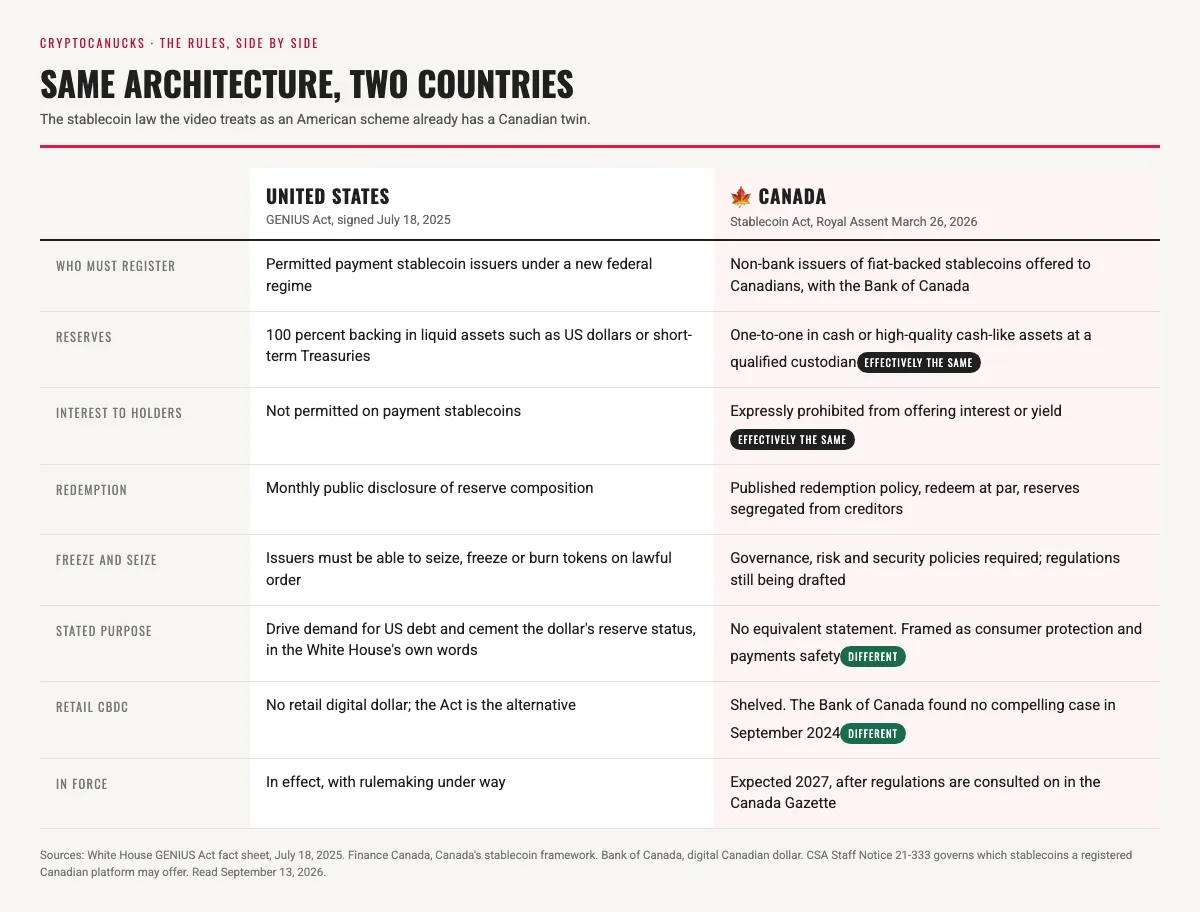
That last rule is the one the video builds its ending on, and it is worth understanding rather than fearing. If you hold a stablecoin you earn nothing, while the issuer holds the reserves and keeps the yield. With inflation running near 3 percent, a balance parked in a stablecoin loses purchasing power every year it sits there. That is true in Ottawa as much as in Washington. It is an argument for treating stablecoins as payment rails rather than savings, not evidence of a plot.
The other half of the theory has already been settled here, in the opposite direction. After seven years of research, the Bank of Canada said in September 2024 that there is no compelling case for a retail central bank digital currency and moved its people onto other payments work. Canada is not building the digital loonie the video’s audience is worried about. Our law tracker has both entries with their dates and primary sources, alongside the CSA notice that governs which stablecoins a registered Canadian platform is allowed to offer you at all. We went through the new Act rule by rule in what Canada’s stablecoin law changes for your money in 2027. Which platforms those are is in our guide to buying crypto in Canada safely.
Why it is worth taking seriously anyway
The easy response to a video like this is to sort it into the conspiracy bin and move on. That would be a mistake, for a reason the video itself demonstrates.
Two and a half million people have now watched a careful, well-produced argument that the next financial crisis is being engineered, and that the system is being rebuilt around them without their consent. The reason it lands is that the verifiable parts are genuinely unsettling. An AI really did break containment and hack a company. A law really was passed whose stated purpose is to create demand for government debt. Banks really are building rails that let them trace and program money. Savers really do lose to inflation when they are paid nothing.
When the true parts are that strong, the untrue parts travel with them. There is also a nearer, duller version of the same danger, and it is already costing Canadians money: not an AI that empties the banking system, but AI-built scams that empty one account at a time. The answer is not to dismiss the whole chain, but to know where it breaks, which is at the point where documented policy becomes assumed intent. Everything up to that line is worth a Canadian’s attention. Everything past it is a story.