On September 6, 2025, a Zcash coin opened at US$40.99 on Kraken. On September 4, 2026 it closed at US$1,023.36, the first daily close above US$1,000 in the coin’s history, and on September 9 it traded as high as US$1,258.99, a new twelve-month high, changing hands around US$1,244 (about C$1,714) as this was published. That is a 30-fold move in twelve months for a coin that spent early 2025 below US$30 and that most Canadian platforms still do not list. This is not a piece about where it goes next. It is the record of how it got here, what the technology underneath it actually does, and what a Canadian who wants to hold it should know.
Every price below is from Kraken’s public daily candles, cross-checked against Coinbase’s. Every protocol fact is from the Zcash documentation, the upgrade proposals or the Zcash Foundation.
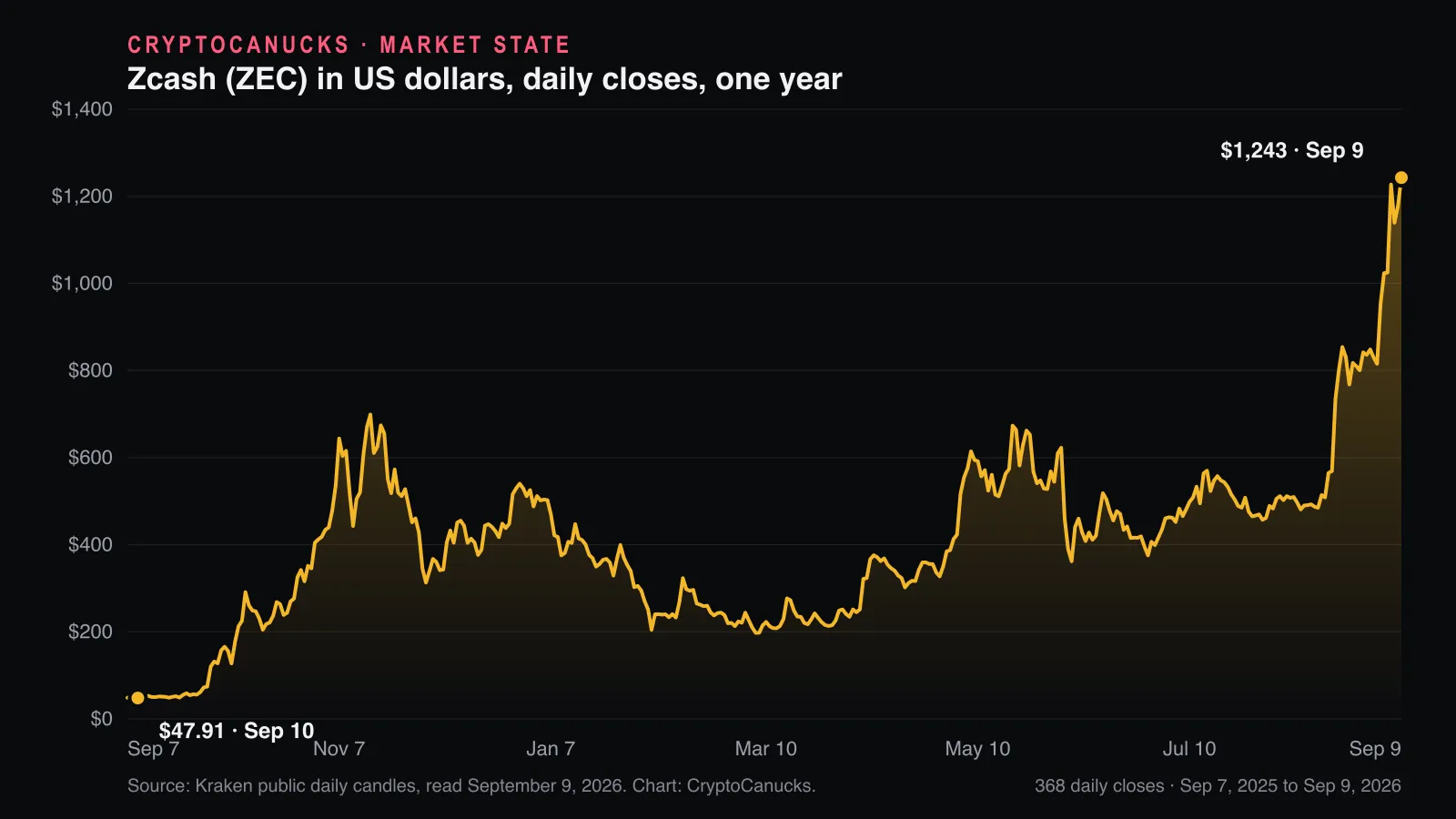
ZEC/USD daily closes on Kraken, September 2025 to September 9, 2026. Chart: CryptoCanucks.
The year, by the numbers
The low came first. Kraken’s daily low for 2025 was US$26.30 on February 3, and the coin was still under US$50 when this twelve-month window opened in September. The move began in October: the month closed at US$404.50, and on November 7 ZEC traded to US$750. Then came the drawdown that every parabolic chart gets. February 6, 2026 printed the 2026 low, US$184.88, a 75 percent fall from the November peak. The second leg was slower: May closed at US$568, June at US$399 and August at US$848. Then September 4 brought the first close above US$1,000, September 6 closed at US$1,227 after a US$1,257 high, and September 9 set the twelve-month high of US$1,258.99. Coinbase’s candles tell the same story to within a dollar or two at every turn.
That volatility is the first thing to understand about the asset. In eleven months it fell by three quarters and then rose more than six-fold, and it moved 10 percent in a day more than once in the past week. Nothing in what follows changes that.
What zero-knowledge proofs do
Bitcoin’s ledger is transparent: every address, amount and counterparty is public forever. Zcash launched in 2016 with the same 21 million coin cap and one difference. Transactions between shielded addresses are, in the project’s own words, “fully encrypted on the blockchain, yet still be verified as valid,” using a cryptographic proof called a zk-SNARK. The network checks that no coins were created or spent twice without learning who paid whom or how much. Zcash’s transparent addresses, the ones that start with “t,” “work similarly to Bitcoin addresses and do not offer privacy.”
For years the privacy was optional and mostly unused, and the original proofs needed a “trusted setup,” a ceremony whose secret parameters, if ever leaked, could have allowed counterfeit coins. The NU5 upgrade on May 31, 2022 replaced that with Halo 2, a proving system the Electric Coin Company built to eliminate the trusted setup, and introduced the Orchard shielded pool alongside the older Sapling pool. The same upgrade brought unified addresses: one address that can receive to transparent or shielded pools, so the sender no longer has to know which kind the recipient uses.
The piece that turned the design into a product was a phone wallet. Zashi, released by the Electric Coin Company in March 2024 and renamed Zodl in February 2026, shields by default and added in-app swaps to and from other chains through NEAR Intents in late 2025. The shielded share of all ZEC, which sat at 12.4 percent on January 1, 2025, passed 30 percent in November and stood at 28.8 percent on September 1, 2026. Josh Swihart, who ran ECC and now leads the successor lab, wrote in May that “the share of shielded transactions has climbed to 86.5% in mid-March.”
Roughly 31%, over $3B in USD terms, is shielded. Josh Swihart, Zcash Open Development Lab, Zcash community forum, May 11, 2026
The upgrades that shaped the year
Zcash changes by scheduled network upgrades, and this year had four.
- NU6, November 23, 2024, was also the second halving. Under ZIP 1015, 8 percent of each block reward goes to Zcash Community Grants and 12 percent into a “lockbox” for future development, with miners taking the rest.
- NU6.1, November 24, 2025, handed control of that 12 percent to coin holders through a voting mechanism and released the accumulated lockbox to a two-of-three multisig held by the Zcash Foundation, the Electric Coin Company and Shielded Labs.
- NU6.2, June 3, 2026, was an emergency. The Zcash Foundation reported that an independent researcher, Taylor Hornby, auditing the protocol for Shielded Labs, found a flaw in the Orchard proof circuit on May 29. A soft fork went in within days and the permanent fix activated at block 3,364,600. The formal write-up, ZIP 257, says the bug “could have allowed balance violation and theft of funds”; the Foundation’s statement says “there is no evidence of unauthorized value creation.” The price at the time was around US$400.
- NU6.3 “Ironwood,” July 28, 2026, opened a new shielded pool designed to make “the integrity of its circulating supply independently verifiable,” with a proposal for recoverability against future quantum computers attached.
The next one is being voted on now. The Foundation’s poll on NU7, open until September 14, covers smoothing the block subsidy instead of halving it, cutting block times from 75 seconds to 25, and retiring the original 2016 shielded pool, with activation pencilled for February 2027 if it passes.
Who bought
Three institutional threads run through the year, all on the public record.
Grayscale’s Zcash trust, which had traded over the counter since 2021, was renamed The Zcash ETF on August 24, 2026 and began trading on NYSE Arca under ZCSH the next day. Its prospectus discloses a 2.5 percent annual fee, all of it to be spent for a year on marketing “in support of the Trust and initiatives that support the development, marketing and education of the Zcash Network,” Coinbase Custody as custodian, and holdings of “approximately 2.3% of the ZEC in circulation” at June 30. Swihart’s comment on the listing: “We (at least at ZODL) are not building a world for ETFs, but this does have advantages: market visibility, legitimacy, liquidity, and regulatory air cover for the dev teams.”
Cypherpunk Technologies, a Nasdaq-listed company backed by Winklevoss Capital, bought 203,775 ZEC in November 2025 at an average of US$245.37, invested in the development lab in March, and by August held 323,394 ZEC, about 1.9 percent of supply, while its mining arm claimed roughly 18 percent of the network’s hash rate.
And the developers reorganized. Swihart wrote that “in January 2026, the entire ECC team left to form Zcash Open Development Lab (ZODL)” after a dispute with its parent’s board, and that ZODL “closed a $25M round from Paradigm, a16z crypto, Winklevoss Capital, and Coinbase Ventures.” The Zcash Foundation, separately, reported US$48.8 million in liquid assets at June 30, most of it in ZEC.
What a Canadian should know
Where to buy it. Of the platforms registered with the Canadian Securities Administrators, Ndax sells ZEC in Canadian dollars, Coinsquare and Bitbuy list it, and Kraken, registered as a restricted dealer in every province, offers it against USD and EUR. Wealthsimple, Shakepay and Netcoins do not list it as of September 9, 2026. We could not confirm Coinbase Canada or Newton either way. The registered list itself is in the buying hub.
Holding it. Shielding only works in a wallet that supports it. The exchange balance is transparent by design; the privacy exists once coins sit in a shielded pool under keys you control. Our self-custody guide covers the device and the backup.
Compliance. Owning a privacy coin is legal in Canada, but FINTRAC’s indicators for reporting entities list a client portfolio that “only consists of privacy coins or has a high value in privacy coins,” and large transfers of bitcoin “in exchange for privacy coins,” among the signs a platform must weigh for money-laundering reports. Large trades will draw questions. The tax treatment is the same as any crypto: a disposition is a taxable event, and the tax hub has the rules. The U.S. ETF is a U.S.-listed security; there is no Canadian-listed Zcash fund.
The risks the record shows. The European Union’s anti-money-laundering regulation bars crypto service providers from keeping accounts that use “anonymity-enhancing coins” from July 10, 2027, which will shape where ZEC can be traded. Binance delisted Monero in February 2024, though not Zcash. The June proof bug was caught by an audit, not an attacker, and the researcher who found it has since asked the community for a US$750,000 bounty. And the chart: a 75 percent drawdown sat in the middle of this year’s move.